

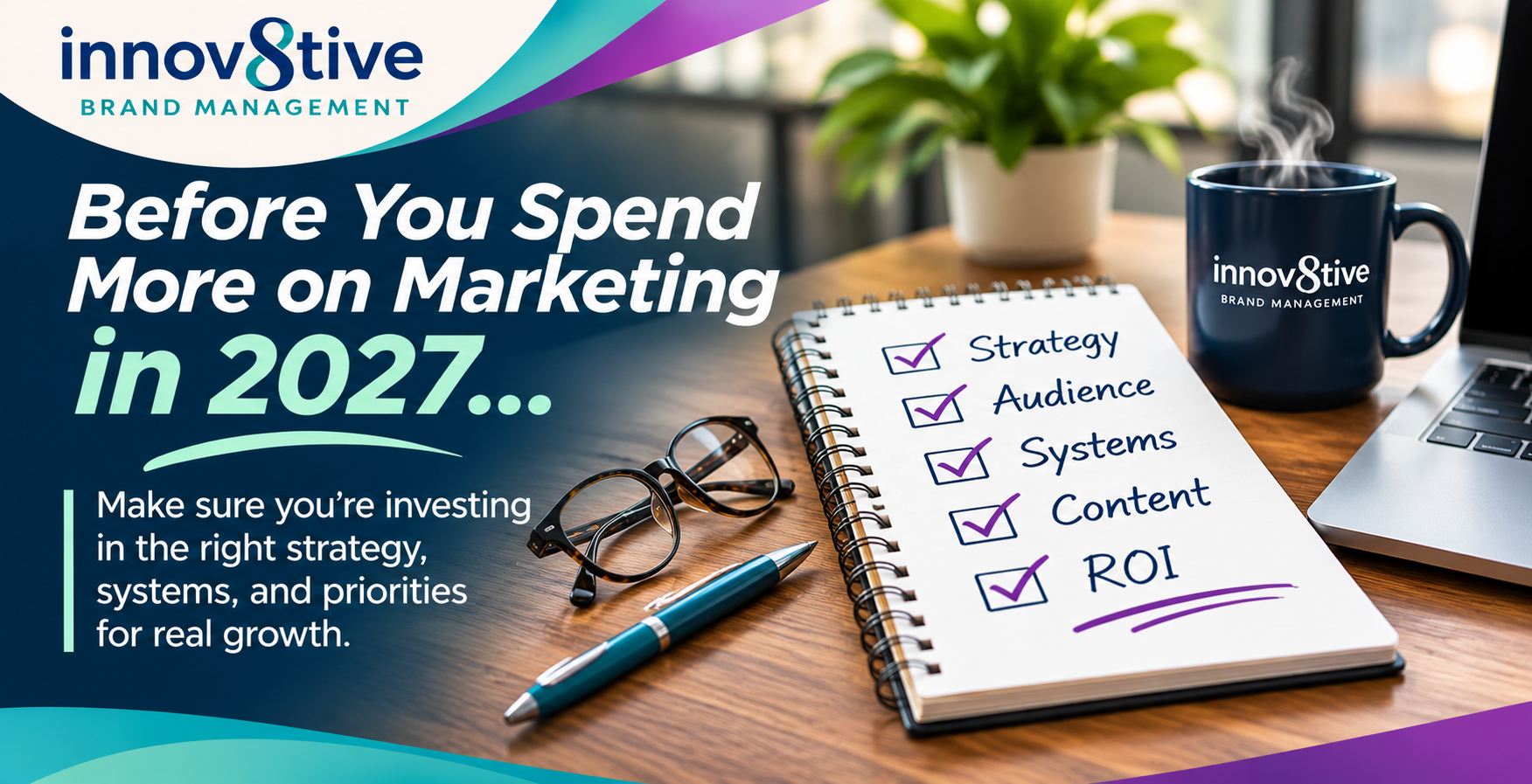
As the end of the year approaches, business owners begin asking familiar questions.
Should we increase our advertising budget? Do we need a new website? Should we be posting more frequently on social media? Is it time to invest in SEO or marketing automation?
These are reasonable questions, but they may not be the right place to start.
Before investing more money in marketing, it's worth understanding whether your current marketing efforts are working together.
Many businesses don't suffer from a lack of marketing activity. They suffer from a lack of alignment.
Their website communicates one message. Their social media communicates another. Their sales process operates independently. Their CRM contains valuable information that never influences marketing decisions.
Individually, these activities may be functioning. Collectively, they may be creating friction that makes growth more difficult.
Here are five common disconnects to evaluate before finalizing your 2027 marketing strategy.
1. Your Brand Message Doesn't Match Your Customer's Needs
Your brand message should help potential customers understand who you serve, what problems you solve, and why your approach is valuable.
But businesses evolve.
Services change. Customer expectations shift. New competitors enter the market. Yet many organizations continue using messaging developed years earlier.
The result can be a brand that no longer accurately communicates its value.
Consider whether your website, social media, email communications, and sales conversations consistently explain what makes your business different.
What to fix: Revisit your ideal customer profiles, core value proposition, and brand positioning before investing in new campaigns.
A clear message makes every marketing channel more effective.
2. Your Website and Marketing Channels Aren't Connected
Your website should support the actions you want visitors to take.
If you're investing in social media, search engine optimization, or advertising, those channels should direct people toward relevant information and clear next steps.
A social media post promoting a specific service shouldn't necessarily send visitors to a generic homepage where they must search for the information themselves.
Likewise, an advertising campaign may attract traffic without producing meaningful inquiries if the landing experience is confusing.
What to fix: Evaluate the path between your marketing channels and your website.
Ask whether visitors can easily find the information promised in your content, understand your offer, and take the next step.
3. Your Lead Generation and Follow-Up Systems Operate Separately
Generating interest is only part of the marketing process.
What happens when someone completes a contact form, requests information, or subscribes to your newsletter?
If inquiries rely entirely on manual processes, important opportunities can be missed.
A CRM can help organize customer information, track conversations, and support consistent follow-up. Marketing automation can assist with timely communications when configured appropriately.
However, technology alone won't solve a poorly designed process.
What to fix: Map what happens from the moment someone expresses interest until they become a customer.
Identify who is responsible for responding, what information is collected, and how the relationship progresses.
4. You're Measuring Activity Instead of Business Impact
It's easy to focus on metrics that are readily available.
Website visits. Social media impressions. Email opens. Followers.
These numbers can provide useful information, but they don't tell the complete story.
A campaign that generates substantial visibility may still struggle to produce qualified inquiries.
Meanwhile, a smaller campaign reaching the right audience may create meaningful business opportunities.
What to fix: Connect marketing performance to business objectives.
Track not only how many people see your content, but also how they engage, what actions they take, and whether those actions support your goals.
Your measurement strategy should help you make better decisions, not simply produce larger reports.
5. Your Marketing Ends at the Sale
Acquiring new customers is important, but sustainable growth also depends on the relationships you build after the initial transaction.
Too often, businesses concentrate on awareness and conversion while overlooking retention, repeat purchases, referrals, and advocacy.
The Customer Value Journey provides a useful framework for understanding these opportunities.
Its eight stages — Aware, Engage, Subscribe, Convert, Excite, Ascend, Advocate, and Promote — help businesses evaluate how they attract, serve, retain, and grow customer relationships.
What to fix: Examine the experience after someone becomes a customer.
Do you have a consistent onboarding process? Do customers receive helpful follow-up? Are there appropriate opportunities to introduce additional services? Do satisfied customers have an easy way to share their experiences?
A complete marketing strategy considers the entire relationship.
Start With Alignment, Not More Activity
As you prepare for 2027, resist the temptation to solve every marketing challenge by adding another tool, platform, or campaign.
First, identify what's already working.
Then look for the disconnects creating unnecessary friction.
Your brand strategy, website, content, CRM, customer communications, and sales processes should support a shared objective.
When those elements work together, you can make more intentional decisions about where to invest your time and resources.
At Innov8tive Brand Management, we help businesses evaluate the entire Customer Value Journey and identify opportunities to improve brand alignment and marketing effectiveness.
Ready to prepare your business for 2027?
Schedule your Free Brand Assessment and discover where your marketing may have room to work smarter.